
30 Jun Engaging local women in maternity research during the Covid-19 pandemic
Home › News & insights
30 June 2020
Engaging local women in maternity research during the Covid-19 pandemic
The past year has been marked by a number of shattering events, which have highlighted entrenched inequities and injustice, particularly affecting people of colour.
The killing of George Floyd by a policeman in Minneapolis, USA, sparked the international #BlackLivesMatter movement. Around the same time, UK statistics showed that more people from black, Asian and minority ethnic (BAME) groups had been dying from Covid-19 than white people, with BAME healthcare workers — GPs, care home staff, porters, nurses, midwives, hospital doctors, ambulance workers — hit hardest.
5×
Black women are five times more likely to die during pregnancy and in the six weeks after childbirth than white women (MBRRACE 2019)
The most recent MBRRACE report also found that Asian women are twice as likely to die, and that women from BAME groups or living in deprived areas have higher maternal death rates. A petition to Parliament set up by the #FiveXmore maternity campaign was signed more than 159,000 times.
It was against this background that the maternity and perinatal mental health theme at ARC South London organised two online Zoom engagement events in mid-June 2020, aimed at local women.
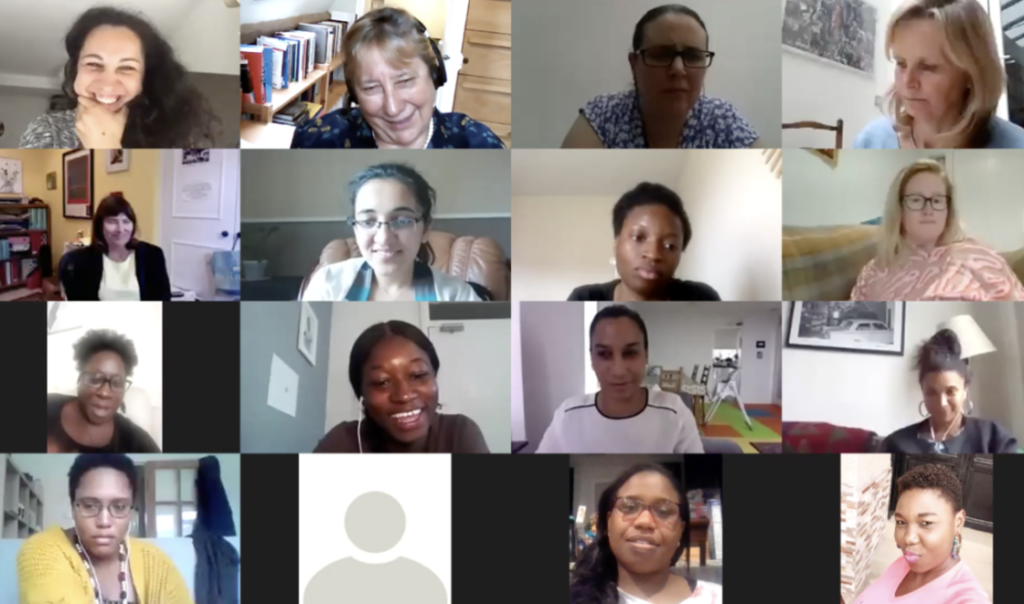
Screenshot from one of the Zoom engagement events, mid-June 2020.
About the events
Over 60 people registered across two Zoom meetings (each lasting 60–90 minutes), with one evening and one afternoon event offered for participants’ convenience. A little under half of those registered attended — not unusual for free, online events where parents with young children may need to change plans at short notice.
The aim was for maternity and perinatal mental health researchers to engage with women in south London, and with networks, groups and organisations working with them, to discuss how to collaborate. Researchers wanted to find out about women’s priorities and concerns, and their thoughts on the ARC’s planned maternity and perinatal mental health research.
Organisations represented at the events
Birth Companions
Mothers for Mothers
Mummy’s Day Out
Perinatal Mental Health Partnership
Make Births Better
Desperate Artwives
Also represented: four London Maternity Voices Partnerships, parents with young children, women with an interest in breastfeeding support, two service user contributors to the national Maternity Transformation Programme, a pregnant woman, four black professionals working in healthcare or research, and several members of the #FiveXmore campaign. Overall, a majority of the women were from BAME backgrounds.
Discussions at the events
Researchers explained they would address known current issues in London: poorer outcomes for women and babies in areas of social disadvantage and from BAME groups, and following up on good practice such as continuity of care. Key applied health research questions included: Why do some groups have poorer outcomes? What models of care can help? How can care and outcomes for women with mental illness be improved?
💬
Peer research and participatory methods
Recommended as a way to empower communities and enable them to have a voice. Emphasised by at least three participants, with trained maternity peer researchers in north London cited as a good example in action.
💬
Unequal services across boroughs
Two participants felt Lewisham and Southwark have less well-resourced health services than wealthier areas. One said: “It’s completely different in different areas… How do you know what standard of care you can expect?”
💬
‘Weathering’ and structural racism
One participant introduced the concept of ‘weathering’: “Weathering has an effect on us like a drop of water on wood, slowly eroding us. Whether its maternity care or cancer, it goes a long way back.” Others agreed: “It’s an institutional, structural issue; influenced by money, influenced by race.”
💬
Continuity of midwife care
Valued highly, though participants identified a weak link when it did not occur during labour and birth, or when women attended a maternity assessment unit for triage.
💬
Perinatal mental health and stigma
The sense of stigma persisting in some cultural groups, particularly older generations, was highlighted. Participants stressed the need for more black women’s childbirth networks and for positive, preventative approaches to preparing for birth that feel welcoming and culturally appropriate.
“Again and again, I’m struck by the importance of the intermediation role, the translator role, which I think we still undervalue… We over-privilege someone with very deep knowledge over someone who’s very good at orchestrating networks to pull in multiple types of useful knowledge.”
Former CEO of NESTA (in Knight and Lyall, 2013)
Reflections and next steps
The ARC researchers felt the online engagement events had worked well. More people attended than would have come to a face-to-face meeting, and there was greater diversity. Several mothers attended with their children; one person stopped their car at the roadside to participate. Professionals joined from Scotland, Nigeria and Washington DC.
Emerging PPI co-production group composition
Black women
White women
Mixed race
A majority expressed interest in perinatal mental health. All London-based service users, community members and charity representatives were keen to continue working with the ARC’s research theme.
The team are setting up:
✓
An overarching PPI strategy group for the theme
✓
A maternity advisory group to sit alongside the existing perinatal mental health advisory group
✓
A broader network of collaborators
✓
Co-production of a PPI strategy with training for service users and researchers, enabling co-designed projects with community involvement from the earliest stages through to writing up and sharing results
Written by Mary Newburn and the ARC maternity and perinatal mental health co-production group
Clotilde Abe, Agnes Agepong, Lucy Angell John, Sakina Ballard, Leah Bedward, Rachael Buabeng, Lauren Carson, Clare Dolman, Abigail Easter, Cristina Fernandez Turienzo, Michele Harris-Tafri, Michele Howard, Anna Horn, Louise Howard, Hannah Rayment Jones, Jane Sandall, Nick Sarson, Sergio A. Silverio, Maria Viner
International collaborators: Heba Farajallah, Shamella Joy and Olajumoke Ojeleye
About the organisations that attended
Works with women who face difficulties — including being in prison, immigration issues, homelessness, financial difficulties, mental ill-health, involvement with social services and a history of domestic violence or sexual abuse — which can make the birth of their baby a time of anxiety, stress and hardship.
A collective of parents and professionals working together to end suffering from birth trauma.
Independent, multi-disciplinary advisory and action forums with service users at the centre, established to work with maternity services throughout south London.
A grassroots organisation of mothers who have suffered and recovered from depression, anxiety or isolation during pregnancy or after the birth of a baby, offering support, advice and information.
A grassroots, social support network for mothers, created online by Rachael Buabeng.
Perinatal Mental Health Partnership
An online non-profit organisation founded to promote awareness of perinatal mental health via an annual awareness week, sharing links to related mental health information and campaigns and lived experience videos.
A maternal wellbeing social enterprise designed to support black and South Asian women during the perinatal period in Lambeth and Southwark for free. Focuses on prevention, social isolation and raising awareness around maternal mental health.
References
Knight C, Lyall C. Knowledge brokers: the role of intermediaries in producing research impact. Evidence & Policy. 2013;9,3:309–316.
Saving Lives, Improving Mothers’ Care. Knight M, Bunch K, et al. MBRRACE-UK. 2019.
The invisible made visible: using impact evaluations to illuminate and inform the role of knowledge intermediaries. Meagher L, Lyall C. Evidence & Policy. 2013;9:409–18.
Related content
- →
Patient and public involvement and engagement in maternity and perinatal mental health - →
Investigating maternal and perinatal outcomes among women from Black, Asian and Minority Ethnic groups - →
MORE — Tackling inequalities in maternity care (Photovoice project) - →
Maternity and perinatal mental health research at ARC South London
Original source: arc-sl.nihr.ac.uk — NIHR ARC South London legacy content archived May 2026.