Optimising outcomes and options for women with a breech pregnancy at term
Home › Research and implementation › Our research areas › Maternity and perinatal mental health
7 January 2021 — adopted November 2020 • completed August 2023
Optimising outcomes and options for women with a breech pregnancy at term (OptiBreech)
Most babies are born head-first, but about 1 in 25 are in a bottom-down position (breech) after 37 weeks of pregnancy, and some are not detected until labour.
1 in 25
babies are in a breech (bottom-down) position after 37 weeks of pregnancy
Breech babies have some increased risk around the time of birth, so most are born by caesarean section. However, caesarean section is also associated with risks for babies, for mothers, and for future pregnancies.
The method of childbirth is a very personal decision. Dr Shawn Walker leads this study to explore how to improve the safety of vaginal breech birth, focusing on the development of competence and expertise among midwives and obstetricians to manage uncommon events like breech births.
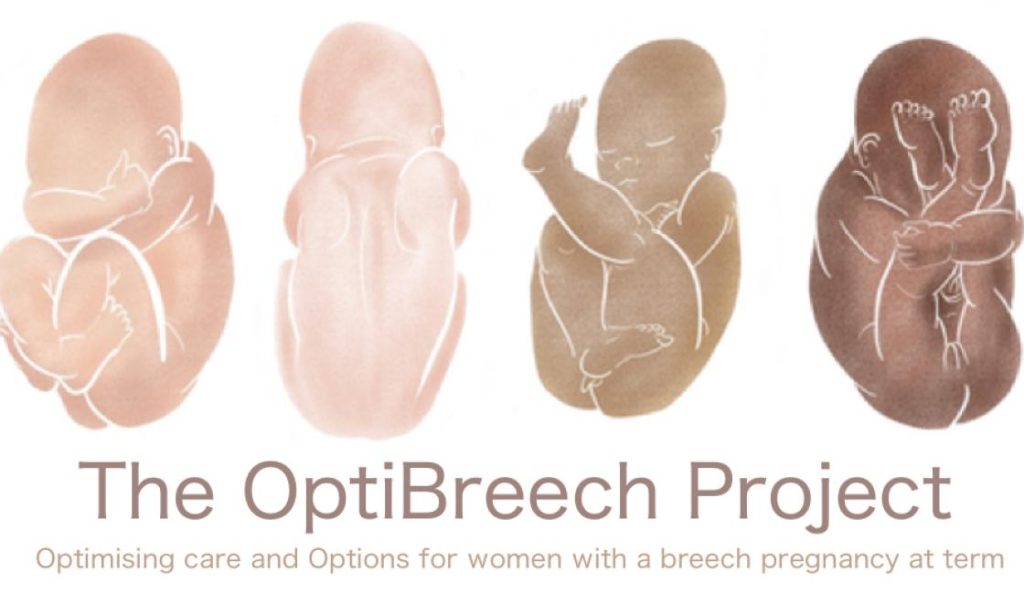
The OptiBreech care pathway
The study aims to investigate whether it is feasible to evaluate a new care pathway for women with a breech pregnancy. The OptiBreech care pathway includes:
Expert-led care from trained specialists in breech presentation management
Structured training for midwives and obstetricians based on the best available evidence
Supporting women to be active participants in their breech birth experience
Women who have experienced breech pregnancies have asked for:
✓
More information about non-caesarean options
✓
Reliable support from an experienced midwife or obstetrician if a vaginal birth is planned
These requests align with national policy to enable maternal choice. The model being tested is based on the best evidence of what could potentially improve the safety of vaginal breech births, as well as improve support for women who choose to give birth vaginally.
How the project was carried out
We do not yet know whether OptiBreech care is as safe and cost-effective as standard care. The first step is a feasibility study — answering important questions needed to design a successful large-scale clinical trial. The study used routine data, interviews and surveys to determine:
?
How many women might wish to take part in a large trial?
?
Can we collect all of the information we need, and how much time does it take?
?
How do women and staff feel about the OptiBreech care pathway?
?
How might we determine what it costs to provide OptiBreech care?
?
How many sites across the UK would be willing and able to participate in a larger trial?
Our collaboration partners
sites across England, Wales and Scotland
Including Kingston University Hospital in south London. An independent Trial Steering Committee considered outcomes from this initial study and advised on whether a large trial is feasible.
How patients and the public are involved
✓
Two lay members on the research team, sitting on the Trial Steering Committee
✓
A PPI group with over 30 members from across the UK — women who had experienced a breech pregnancy in the last five years, including outcomes of vaginal breech birth, caesarean section and birth after external cephalic version (ECV)
✓
In preparing the funding application, feedback was sought from service users via the NIHR Research Design Service London Fast Track Review, a full review by the Birth Trauma Association, and meetings with local Maternity Voices Partnership groups
✓
Engagement events held with stakeholders including service users, midwives, obstetricians, anaesthetists, neonatologists and commissioners as the project developed
Research lead

Dr Shawn Walker
Consultant breech specialist midwife and lecturer in midwifery, King’s College London
Related content
- →
OptiBreech feasibility study — scientific abstract (optibreech.uk) - →
Improving health outcomes for women and babies at higher risk of complications during pregnancy and birth - →
Maternity and perinatal mental health research at ARC South London
Original source: arc-sl.nihr.ac.uk — NIHR ARC South London legacy content archived May 2026.