
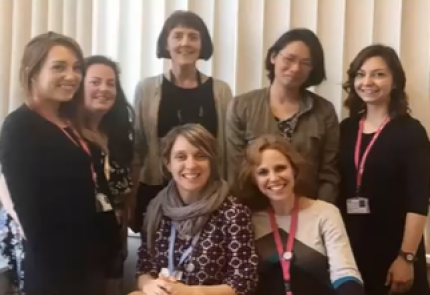
16 Feb More than 250 clinicians, service users, researchers and policymakers join event on midwifery continuity of carer
Home › News & insights › Latest news
16 February 2022
More than 250 clinicians, service users, researchers and policymakers join event on midwifery continuity of carer
The ARC’s maternity and perinatal mental health research team held an online seminar on Friday 11 February exploring the latest research evidence on midwifery continuity of carer, attended by more than 250 service users, researchers, clinicians and policymakers from across England.
attendees from across England
presentations of research findings on continuity of care models
2022 online seminar chaired by Professor Jane Sandall CBE
Models of midwifery continuity of care are recommended in international guidance and are at the heart of maternity policy in the UK. These models — in which the same midwife or small team of midwives provide care during pregnancy, birth, and the early parenting period — have been found to improve outcomes and experiences of care among women at low- and mixed-risk of complications.
About the event
The event was chaired by Professor Jane Sandall CBE, theme lead for maternity and perinatal mental health at ARC South London and professor of women’s health & social sciences, King’s College London, who led an influential international Cochrane review into the evidence on midwifery continuity of carer. It was designed as an opportunity to share experiences from many perspectives — exploring what researchers already know and where more evidence is needed.
Presentation 1: Findings from the POPPIE trial
The first presentation explored findings from a new model of care in Lewisham in which women who are likely to give birth prematurely receive care from a specialist team of midwives before, during and after their pregnancy — known as the POPPIE trial.
The presentation was led by the POPPIE team and included a powerful contribution from Jessica George, a service user who experienced the model first-hand.
“It was a very scary experience. But when I got to the hospital it was a friendly face who I’d seen many times who met me and that puts your mind at ease.”
“If everyone had the POPPIE experience, even with another lockdown, the care of a woman would be so much better managed because it’s the same person who would know everything about that woman. […] You really build up that relationship; your husband, your partner, even my mum, knew my midwife, and that’s such an underrated blessing.”

Jessica George
Service user, POPPIE trial participant
Presentation 2: Maternity care for women with social risk factors
The second presentation was led by Dr Hannah Rayment-Jones, research fellow at King’s College London, who outlined findings from her PhD examining and comparing models of maternity care that could improve clinical outcomes and experiences for women and infants living socially complex lives — known as Project 20: maternity care for women with social risk factors.
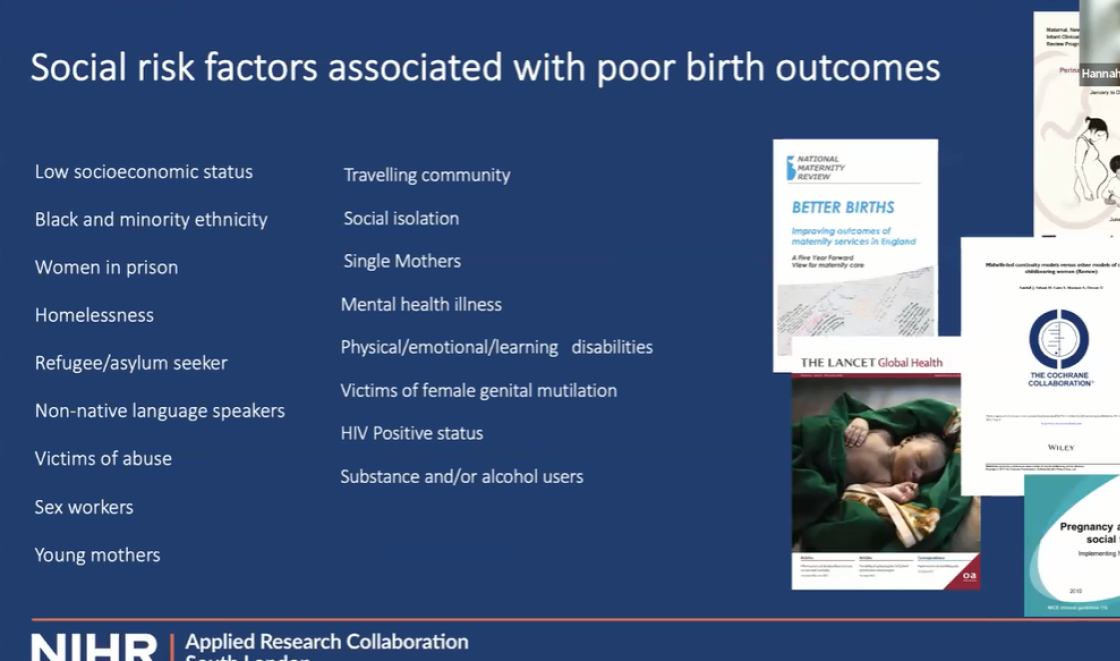 Social risk factors associated with poor birth outcomes, from Dr Rayment-Jones’s presentation.
“We don’t know the underlying causes of health inequalities for women; we don’t know what models of care improve women’s outcomes and how; who benefits the most; whether these models of care are safe and acceptable; and if they are stigmatising. Overall, there has been a lack of evaluation of these models.”
Dr Hannah Rayment-Jones, research fellow, King’s College London
Dr Rayment-Jones highlighted the social risk factors associated with poor birth outcomes and the urgent need for evidence-based models that can improve care and experiences for the most vulnerable women.
Presentation 3: Community-based continuity of care in Lambeth — the LEAP trial
The final presentation came from the Lambeth Early Action Partnership (LEAP) caseload team — a community-based continuity of care model for women living in areas of social disadvantage and ethnic diversity in Lambeth. Issy Bourton, the LEAP midwifery practice leader, outlined findings from the LEAP trial published in BMJ Open.
Preterm birth rate — caseload midwifery vs traditional care
Caesarean section rate — caseload midwifery vs traditional care
Emergency caesarean rate — caseload midwifery vs traditional care
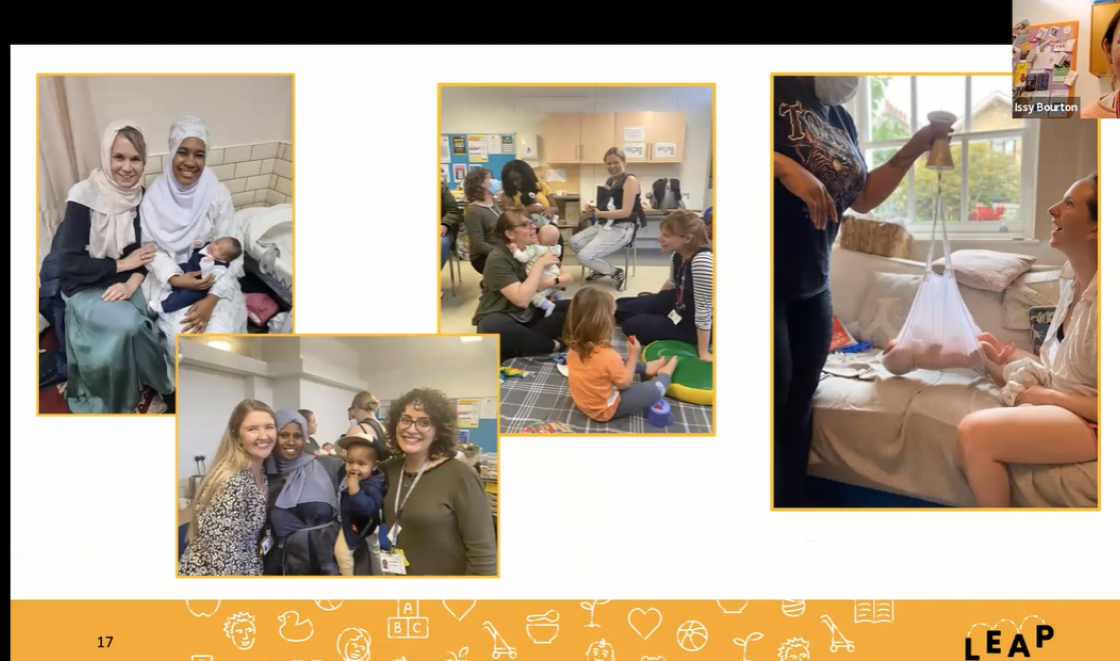 The LEAP caseload midwifery team in Lambeth.
Panel discussion
Following the three presentations, a panel discussion was chaired by Zenab Barry, Chair of Council, National Maternity Voices and Co-Chair of the Chelsea and Westminster Maternity Voices Partnership, bringing together all presenters for a wider conversation with attendees.
Find out more
- →
Presentation slides: Implementation findings of the POPPIE trial (PDF) - →
Presentation slides: Project 20 — maternity care for women with social risk factors (PDF) - →
Presentation slides: Lambeth Early Action Partnership (LEAP) caseload team (PDF) - →
Event programme (PDF)
Related content
- →
Continuous care from community-based midwives reduces risk of preterm birth by 45% — news, January 2026 - →
Caseload midwifery significantly reduces rates of preterm birth and caesarean — news, November 2021 - →
Models of maternity care for women living in areas of ethnic diversity and social disadvantage (LEAP) - →
Improving health outcomes for women and babies at higher risk of complications — impact case study
Original source: arc-sl.nihr.ac.uk — NIHR ARC South London legacy content archived June 2026.