
20 Jan “I’m making it up as I go along!” Why we need to build capacity for community involvement and service user-led PPI in research
Home › News & insights › Blog and commentary
20 January 2023
“I’m making it up as I go along!” Why we need to build capacity for community involvement and service user-led PPI in research
Why is it important to work on capacity building in the involvement of the public, communities, and service users in research? Mary Newburn, Rachael Buabeng, Sarah Fisher and Zoe Vowles — all involved in the ARC’s maternity and perinatal mental health research — reflect on this question.
Rachael Buabeng
Sarah Fisher
Zoe Vowles
Thinking about involvement in research strategically
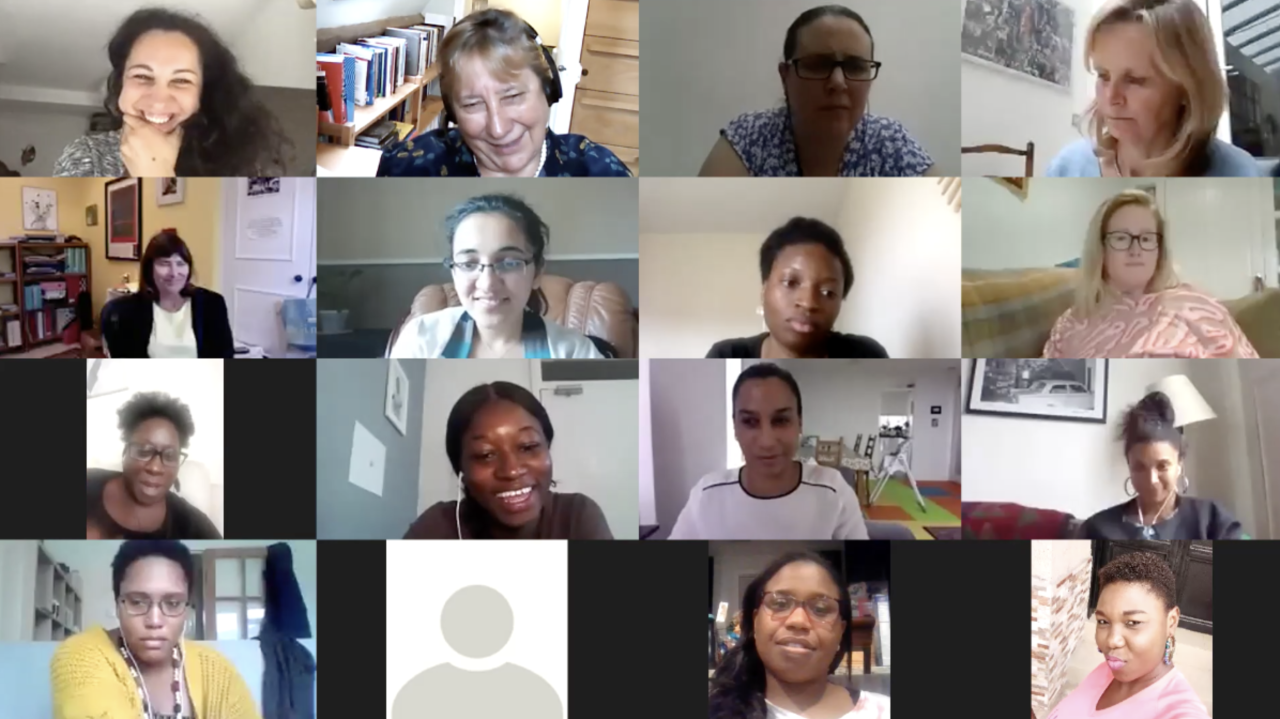
Each year in November, the maternity and perinatal mental health theme at ARC South London meets online to consider public involvement in research strategically. We ask: “How is this work going? What needs to change to improve what we do?” The patient and public involvement and engagement (PPIE) strategy group is multidisciplinary, including community members, maternity voices partnership members, researchers, and policy and community engagement leads from relevant charities.
In 2022, the focus of the meeting was PPIE leadership: capacity building. Our research theme has a culture of this work being led by an experienced service user researcher, Mary Newburn, who has worked in maternity with parents’ charities for several decades in policy, information, service user research and PPI roles.
The NIHR says that the role of PPI lead can be taken by ‘any of the co-applicants within the research team (or a named member of the team), who has the relevant skills, experience and authority to be accountable, represent, manage and embed patient and public involvement in all aspects of the research study/programme.’
Part of the PPI lead role is to ensure that there is a plan for PPI, and that activities necessary to achieve PPI goals are fully costed and included in the budget. ARC South London has developed an involvement strategy which aims to increase equity, diversity and inclusion (EDI) across involvement in the ARC. In terms of capacity building for PPI, this may have a number of implications, including identifying:
- →
How more diverse groups and communities would like to work with researchers
- →
What motivates individuals and community social media networks to become involved
- →
What support and training may be needed
- →
What help may be needed to develop a realistic budget for responsive, inclusive, enabling and reciprocal PPI activities
PPI leadership: capacity building
The need to build capacity around PPI leadership was illustrated when Mary was contacted by a new PPI lead — a recent service user who had been invited to be a co-applicant in a study as the lead for patient and public involvement in research.
“I’m making it up as I go along. I need some help.”
Priyanka (not her real name), new PPI co-applicant
Priyanka had gone to considerable lengths to become well informed about her options as a pregnant woman. She had been pro-active about connecting with other women with similar interests and had set up a peer-support group. But she was new to the process of facilitating involvement in research — and wanted help on what to do, what not to do, and how to go about it.

PPI lead, maternity and perinatal mental health theme, NIHR ARC South London
In the PPIE strategy group meeting, four external contributors were invited to share their work and reflect on building capacity for PPI leadership. Associate Professor Rachel Rowe (National Perinatal Research Unit, University of Oxford), working alongside experienced PPIE Lead Rachel Plachcinski, introduced a new study for which PPI mentoring had been built into the budget for two new PPI co-investigators.
Rachel Plachcinski described how effective and enabling service user PPI leads need to develop skills including: how to listen, how to engage diverse groups, how to facilitate and reflect a range of experiences, and how to take up the role — assertively, when necessary — as a ‘critical friend’ to researchers. She noted that a national network for service users involved in maternity and perinatal mental health research would be valuable for sharing ideas, practical solutions and good practice.
Both Rachels viewed PPI mentoring as essential in enabling a more diverse range of people to become involved in research with the learning, support and guidance they need.
Improving care and experiences through involvement

Black maternal health advocate, Founder of Mummy’s Day Out, involvement member, NIHR ARC South London
Rachael Buabeng spoke about her motivation as a Black woman to collaborate with researchers, describing how personal pain can be turned into a sense of purpose to improve care and experiences for other pregnant women and families. Her key message: Black women’s participation in PPI is essential to ensuring that Black women’s experiences are captured in research.
“This matters for my community, as we need to create formal knowledge of diverse lived experiences. My motivation is that this will inform change to improve the quality of care and support for families. Engaging with my community requires building of trusting reciprocal relationships, where we get our priorities and needs heard — and met — as well as researchers getting answers to their questions.”
Rachael Buabeng
“As a community leader, I can help to bridge the cultural and language gaps between Black women and many researchers. Removing barriers to participation for my community, and helping researchers understand such barriers, motivates me to be the part of the change we want to see in research.”
Rachael Buabeng
Rachael added that involvement in the research process had “ignited a passion for me to develop my own skills in research.” Capacity building must therefore create opportunities for individuals contributing from a service user perspective to gain personal growth — through speaking at events, writing and being published, and learning new skills.
How peer support and buddying could support involvement
Jo Dagustun, a volunteer with the charity AIMS, reflected on her journey into PPI in research, having already completed a PhD from a service user perspective. She noted that there is a steep learning curve for new service user PPI leads and that unmet support needs are common, including the need for peer support and mentoring.
Sarah Fisher, a service user researcher, proposed a buddy scheme as a practical way to support new public contributors to research — particularly in online involvement group events, which can be intimidating for newcomers.
“Pairing a new member up with someone who has been involved for a while, for a chat before and after their first meeting, could be useful, as well as informal catch ups, checking-in and general support. Perhaps if the buddy gets to know them and their experience, they could introduce them and help to bring them into the conversation at meetings.”
Sarah Fisher, service user researcher
Supporting researchers with involving diverse service users

Midwife researcher, NIHR ARC South London
Zoe Vowles, a midwife researcher, reflected that researchers also need access to training, support and mentorship to be able to reach out and involve a diverse range of service users, community members and charities in positive ways.
“There is sometimes an assumption that researchers know how to involve service users and the public; when in reality there is a distinct set of skills required to engage with communities and reach out to diverse groups of people. This needs to be factored into the training and development of early career researchers just like learning about different research methodologies and other skills.”
Zoe Vowles
“Working alongside Mary and building relationships with the members of the PPIE network has given me so many opportunities for learning and reflection, which can’t be found in a training course.”
Zoe Vowles
Summary
In the ARC’s maternity and perinatal mental health theme, having an annual PPIE strategy meeting makes space for further learning and planning. Each year, the theme agrees a focus for the meeting based on articles or issues that have arisen, and invites external speakers drawing in community members, PPI contributors, researchers, and those leading PPI from across the ARC network.
Our research theme has led the way in enabling community members and service user researchers to take up the role of PPI lead and co-investigator. For this to continue — and to increase the diversity of those involved — there must be investment in building capacity among service users and community members. Further work needed includes:
Pairing new contributors with experienced members to ease the transition into involvement
Structured support for new PPI leads from experienced service user researchers
Regional and national networks for rapid learning and peer support in maternity PPI
PPI activities must be planned creatively and costed comprehensively, with funding for community relationship building, facilitation, leadership, administration and development work throughout — including careful attention to funding service users for their time during bid writing, peer review and set-up phases, not only once a project has officially started.
About the authors
 Mary Newburn Patient and public involvement lead, maternity and perinatal mental health theme, NIHR ARC South London |
 Rachael Buabeng Black maternal health advocate, Founder of Mummy’s Day Out, involvement member, NIHR ARC South London |
 Zoe Vowles Midwife research assistant, maternity and perinatal mental health theme, NIHR ARC South London |
 Dr Abigail Easter Deputy lead, maternity and perinatal mental health theme, NIHR ARC South London |
Find out more
- →
Guidance for Researchers: PPI Feedback — NIHR ARC East of England - →
Patient and public involvement and engagement in maternity and perinatal mental health - →
Public involvement blogs, papers, reports and presentations - →
Maternity PPIE — patient and public involvement in our research
Original source: arc-sl.nihr.ac.uk — NIHR ARC South London legacy content archived June 2026.