
22 Aug My research journey – valuing lived experience in health research
Home › News & insights › Blog and commentary
22 August 2024
My research journey – valuing lived experience in health research
In this blog Vita Moltedo, a co-founder of Maternity Voices Matter and public involvement member of ARC South London’s maternity and perinatal mental health theme, discusses how she became involved in applied health research.

Co-founder of Maternity Voices Matter. Participatory appraisal-trained peer researcher, member of ARC South London’s maternity and perinatal mental health PPIE network, and member of the ARC South London Public Research Panel.
My experience with research is closely linked to my lived experience and my story of childbirth and motherhood. Before the birth of my son George, my understanding and exposure to academia was limited to a very abstract idea which I had developed during my university studies in English literature. I never expected to become involved in healthcare research other than very occasionally — as a patient.
However, my own personal journey into motherhood changed all that. My somewhat surprising and to a degree traumatic experience of childbirth and the months that followed led me to initiate, develop and expand my understanding and knowledge of how members of the public can be involved in research. I now appreciate how we can learn about ourselves as patients and learn about the research which underpins our healthcare system, while contributing towards improved communication with academics and healthcare professionals.
I have learnt about developing new ways of collaboration through engagement, involvement and co-production.
 Maternity and perinatal mental health theme and participants at the Lambeth Listening event.
New opportunities
As one thing leads to another, my involvement with the ARC South London Maternity and Perinatal Mental Health Theme over the past few years brought me to become part of a team of researchers, peer researchers and a PPIE lead at King’s College London. We co-designed and co-produced a project aimed at bringing together a group of parents from Lambeth from diverse ethnic and socio-economic backgrounds to tell their stories of maternity and discuss the positives and negatives they encountered throughout their experience of care.
This idea, which started with two listening events, developed across the year into the MORE (Maternity Opportunities for Research Engagement) project — a piece of qualitative research underpinned by participatory research methods, which received ethical approval in 2024. The project culminated in an exhibition of photographs taken, curated and captioned by service users, showcasing PhotoVoice — a participatory research method introduced jointly to participants and the research team.
Just as we were embarking on this second phase of our project, we were invited by the Impact and Engagement team at King’s College London to take part in the Expert by Experience: Who Knows Best? Exhibition which took place as a takeover exhibition at the Science Gallery London.
Our small team was absolutely thrilled to be able to present the MORE project on this platform, but we could not imagine what a brilliant opportunity this would be to collaborate and take part in the co-planning of the exhibition as well as the execution of it, whilst challenging our own opinions and preconceptions on the concept of “expert” and “expert by experience” in an engaging, inspiring and safe environment, with the luxury of being able to discuss and develop new ideas with a group of co-researchers from different backgrounds over the period of several weeks.
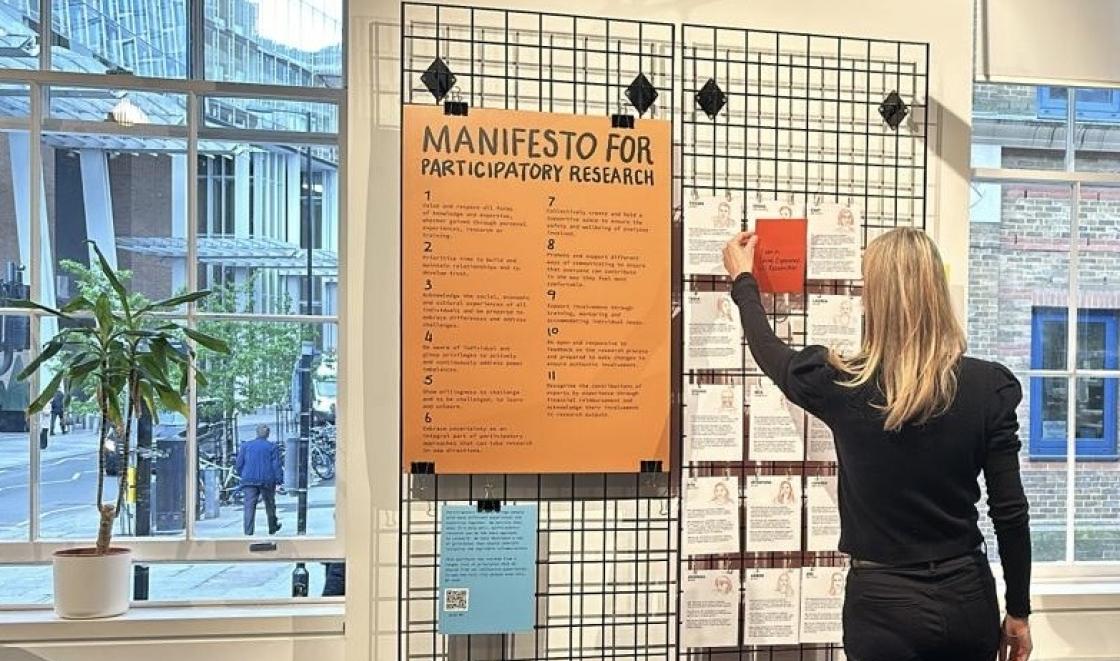 Vita at the Experts by Experience: Who Knows Best? exhibition, Science Gallery London.
Showcasing experts by experience
The exhibition showcased several other projects alongside ours, including the RE-STAR study, and included a manifesto as well as other creative pieces, which we collaboratively developed by meeting, discussing, pondering, and creating, to challenge ourselves and visitors to the exhibition.
At the core of the project was the question “What makes an expert?”, followed by so many more: What is “expertise”? Who decides who is an “expert” and why? Is it still possible to rely on traditional hierarchical systems in research? Are these tested and tried structures facilitating or hindering research?
“By acknowledging the existence and value of lived experience as part of the research process, we inevitably elevate the function and role of members of the public who are actively involved in research – who are in fact Experts by Experience, giving them thus a newfound dignity within the research space. However, awareness and acknowledgment from the research community are not enough. Just as the concept of inclusion is not as simple as asking someone to take part, collaborating and involving members of the public in research takes a few more conceptual and practical steps than is immediately apparent.”
Challenging the idea of experts
Acknowledging not just someone’s experience but being able to quantify it in some way as to give it the value and dignity it deserves is not simple. Academic careers are hard and strewn with obstacles. However, it is possible to recognise the steps taken throughout one’s academic journey. Once those steps are climbed, an academic researcher gets rightfully awarded a formal role and title, which is widely recognised.
By contrast, there is no standard recognition in titles in one’s personal life. Yet, we are all arguably experts in our own lives. One of the pieces showcased within the exhibition was the interactive “card game” — a collection of cards featuring a short bio and the portrait of either a researcher or co-researcher — which challenges the visitors’ potential preconceptions of what makes someone an expert and reveals the plurality of the idea of expertise.
Nearby, a large roll of paper invited visitors to reflect and write what they are experts in. The numerous responses which appeared over the duration of the exhibition were a collection of drawings, doodles, words and sentences – some funny or touching, some light-hearted or well-considered and others provocative and challenging. It was fascinating to keep returning to the exhibition every few days and see how different some responses were and how the roll was taking a life of its own.
Specifically, within healthcare, it is fundamental for researchers and people with lived experience to have an ongoing conversation and a frank exchange that is founded on mutual trust and respect. In order to achieve this, it is necessary to have a system in place which allows for the difference of circumstances and backgrounds, as well as a well-planned and easy-to-execute payment system for everyone involved.
The maternity and perinatal mental health theme receiving their King’s Engaged Research Network Award. From left: Mary Newburn, Tania Sutedja, Vita Moltedo, Zenab Barry, Abigail Easter, Kaat de Backer, Jane Sandall and Zoe Vowles.Throughout my experience of patient and public involvement and peer research, I have been lucky to have come across some projects and spaces which have truly valued the role of people with lived experience involved in research. The Experts by Experience: Who Knows Best? exhibition has certainly been one of these examples. It was inspiring to be meaningfully involved and acknowledged right from the start of the planning process and throughout. The Manifesto which we collectively produced is one concrete example of this collaboration.
Support, trust and respect
I must also mention a couple of other spaces where I have felt trusted and respected as a public member and a person with lived experience: the ARC Public Research Panel — a truly diverse group of people, all of whom have strong links in the community and a deep interest in healthcare research. As a panel, our trust in each other has grown and strengthened over time, just as our understanding of public involvement in many branches of healthcare research. The time it takes to create and maintain such an active and effective group of public involvement representatives, who can meaningfully affect and at times shape research, cannot be underestimated.
Similarly, I have felt truly stimulated and inspired by the PPIE work which I have been doing as a public member of the ARC’s maternity and perinatal mental health theme. Within this group I have been genuinely supported, and I was able to take part in several projects and most recently to take on the role as a peer researcher within the MORE project outlined above.
“Being involved in healthcare research as a member of the public is a meaningful and important activity, but it is fundamental to have the right support throughout. The relationship between academic research and experts by experience can be edifying and inspiring, as long as there is the right attitude on both parts and the right conditions that have been carefully and conscientiously considered.”
There can be various ‘invisible’ obstacles to the success of this relationship but the satisfaction by far exceeds the difficulties. I would encourage anyone with an interest in research to get involved, provided that their motivation and objectives are clear.
My personal motivation corresponds with my objective – which is to help improve healthcare services through research and thus reduce health inequalities. A simple yet complex endeavour!
Find out more
- →
Patient and public involvement in maternity and perinatal mental health at ARC South London - →
Expert by Experience: Who Knows Best? exhibition — Science Gallery London - →
The Experts by Experience Manifesto — King’s College London (PDF) - →
ARC South London Public Research Panel - →
Report: How do peer researchers make a difference? Report of a maternity peer-researcher listening event — Barry, Newburn, Moltedo et al. (PDF)
Original source: arc-sl.nihr.ac.uk — NIHR ARC South London legacy content archived May 2026.
No Comments