27 Nov My experience at the NIHR ARC South London Research Leadership Academy
Home › News & insights › Blog and commentary
27 November 2024
My experience at the NIHR ARC South London Research Leadership Academy

I completed the NIHR Applied Research Collaboration (ARC) South London’s Research Leadership Academy in June 2024, and the learnings from this experience remain with me. Designed and led by Professor Priscilla Harries and her dedicated team, including Aoife Keohane and Bernadette Corrigan, this transformative programme shaped my approach to research leadership and project management. I am especially grateful for the team’s kindness in accommodating my late entry to the programme, which allowed me to learn alongside an inspiring group of professionals.
Why I joined the Leadership Academy
In November 2023, I began my research career as a research assistant with the Southwest London Integrated Care System’s Research Cafe Study, funded by NHS England. This Research Engagement Network Project was a key step in my career, focusing on creating accessible research engagement platforms for underrepresented groups. My background includes five years as a physiotherapist in India, working in both public and private sectors, including with Goa’s Directorate of Health Services, where I contributed to the National Programme for Health Care of Elderly. This experience deepened my passion for public health and motivated me to pursue an MSc in Public Health at the London School of Hygiene and Tropical Medicine in 2022.
Since October 2024, I have been working as a project officer with King’s Improvement Science, focusing on mixed-methods quality improvement and implementation projects across the King’s Health Partners and the South East London Integrated Care System. Additionally, as project manager for the South West London Research Support Network, I collaborate with the South West London Integrated Care System to foster diversity in research participation and engagement. Committed to health equity and community involvement, I joined the Academy to build on my skills in leading projects that bridge research and impactful public involvement.
 Photo: Sapna Kurade, second from right at the celebration event at the end of the Leadership Academy.
Core learnings and practical applications
The Academy’s lectures introduced me to various aspects of research leadership, each greatly relevant to my work. Fifteen lectures were offered, examples included:
Dr Gita Ramdharry highlighted the bridge between clinical practice and research, underscoring the role of evidence-based interventions in improving patient outcomes — a principle I integrate into my public health work.
Professor Richard Harding discussed strategic global health partnerships, particularly in the context of palliative care. His insights on cross-border collaborations reinforced my appreciation for international partnership-building, vital in advancing inclusive research.
Professor Sir Graham Thornicroft shared effective strategies for establishing and sustaining research collaborations. His emphasis on the “best team” approach and consortium longevity provided practical guidance for interdisciplinary partnerships.
Irrum Afzal detailed the legal and financial responsibilities in research projects, focusing on contract types and project monitoring. These skills are instrumental in managing collaborative projects within the NHS.
Jane Haycocks explained budgeting and grant applications, covering essential aspects like Full Economic Costing and funder guidelines — knowledge vital for sustaining public health projects.
Professor Fiona Jones introduced the Theory of Change as a framework to link project activities to long-term outcomes, ensuring that research directly benefits the communities involved.
Savitri Hensman and Professor Tushna Vandrevala emphasised the need for equality, diversity, and inclusion (EDI) in research — a central focus in my work in the Research Support Network, where I build trust within underserved communities.
Insights gained through mentorship
One of the most valuable aspects of the Academy was the opportunity to learn from distinguished leaders, whose guidance has had a lasting impact on my journey. At the Academy we received guidance on how to approach a mentor and I was fortunate enough to secure more than one:
Professor Fenton’s advice on aligning personal values with professional goals and embracing humility was deeply inspiring. His encouragement to seek diverse experiences and bridge theory with practice has helped me refine my public health leadership approach.
Observing Professor Owolabi’s leadership during a NICE meeting reinforced the power of authentic leadership. Her encouragement to identify gaps and pursue opportunities that energise me was a timely reminder to stay grounded in work that aligns with my values.
Professor Dougall’s mentorship was incredibly supportive, especially in helping me acknowledge the challenges of immigrating to a new country and transitioning careers. She encouraged me to confront imposter syndrome, celebrate my achievements and recognise the unique perspectives I bring to my work.
“People are often more willing to help than we imagine, and even the seemingly ‘unreachable’ can be within reach when we show enthusiasm and proactiveness.”
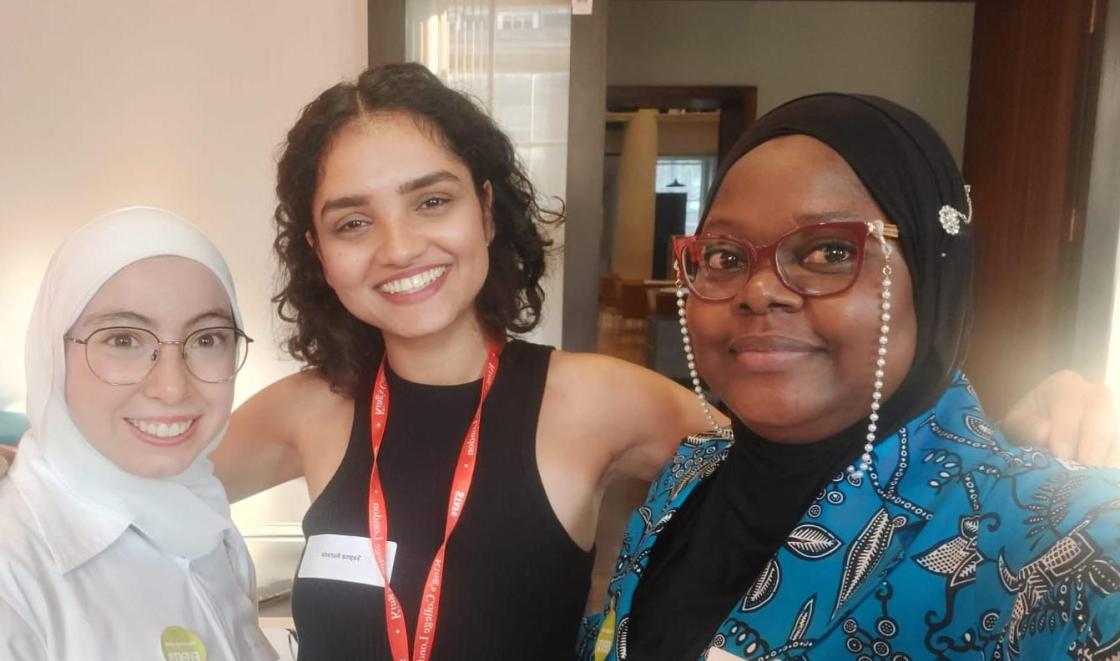
 Photo: Alaa Albawab (PhD candidate, Kingston University), Sapna Kurade, and Shukrat Salisu-Olatunji (PhD candidate, University of Leicester).
Reflections on Action Learning Sets
My Action Learning Set members offered a supportive environment where I could share challenges and receive constructive feedback. Their empathy and open-mindedness have been especially meaningful during this pivotal career phase, reinforcing the importance of community in overcoming professional as well as personal obstacles.
Encouraging future leaders to join the Academy
For anyone considering the Research Leadership Academy, I highly recommend it. It offers an excellent blend of skill-building, mentorship, and peer support, essential for those aspiring to lead impactful initiatives.
The path forward is one of continuous learning, grounded in the principles of humility, integrity, and community. I am grateful for the experiences and connections from the Academy that will guide my future undertakings and I am excited to apply these lessons to promote inclusive research that drives health equity and positive change for all.
Project Officer, King’s Improvement Science
Project Manager, South West London Research Support Network
Related content
- →
ARC South London Applied Research Leadership Academy - →
Patient and public involvement and engagement in maternity and perinatal mental health - →
Resources to support involvement in research - →
Maternity and perinatal mental health research at ARC South London
Original source: arc-sl.nihr.ac.uk — NIHR ARC South London legacy content archived May 2026.