
25 Mar Maternity teams highly commended in NIHR Impact Prizes 2025
Home › News & insights › Latest news
25 March 2025
Maternity teams highly commended in NIHR Impact Prizes 2025
Congratulations to the maternity research teams in the Capacity Research Innovation Building maternity Systems in Sierra Leone (CRIBS) and Preterm pre-eclampsiA PlAcental Growth factor testing for reduction of Adverse Outcomes (PAPAGAIO) Global Health Research Groups, who were recognised as highly commended finalists in the NIHR Impact Prizes 2025.
The NIHR Impact Prizes 2025 recognise major improvements in health over the last two decades, driven by research and scientific advances. The prizes celebrate researchers and teams who have had a major impact on the health and wealth of the nation, as well as globally. The NIHR received over 130 strong applications for the first-ever NIHR Impact Prizes.
🏆
NIHR Impact Prizes 2025
Two ARC South London maternity research teams recognised as Highly Commended Finalists from over 130 applications nationwide
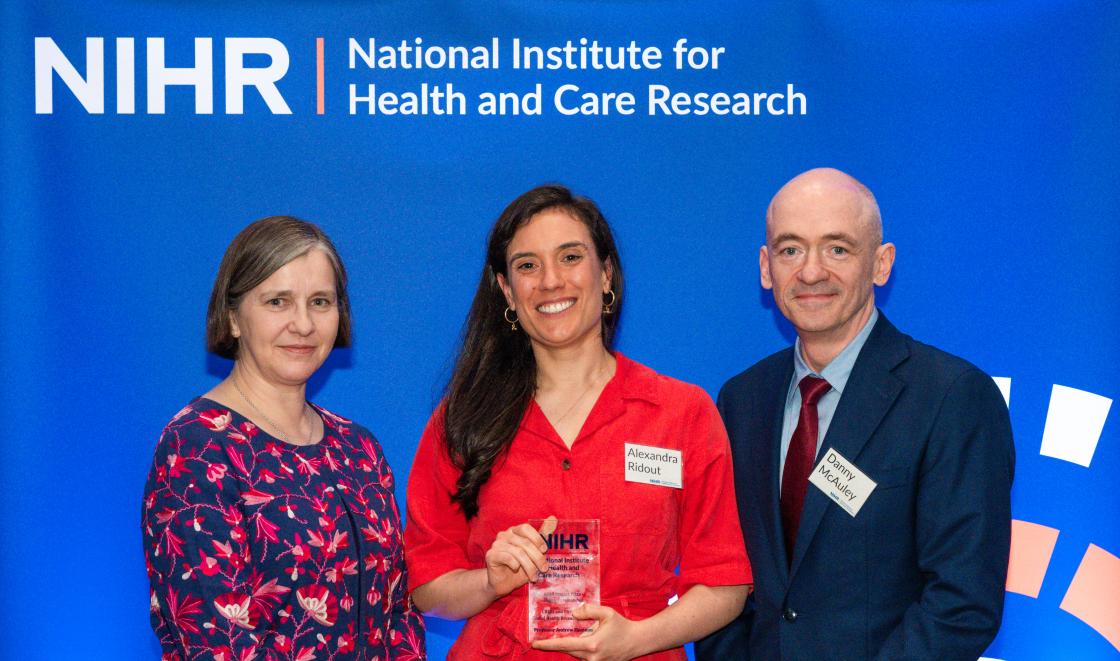
Dr Alexandra Ridout (centre), Clinical Lecturer at the Department of Women & Children’s Health, King’s College London, accepted the award from Professor Lucy Chappell, Chief Scientific Adviser at the Department of Health and Social Care and CEO of the NIHR (left), and Professor Danny McAuley, Scientific Director for NIHR Programmes (right), on behalf of the team.
The CRIBS Global Health Research Group
The CRIBS Global Health Research Group has been working in partnership to implement simple, scalable innovations to reduce maternal and perinatal morbidity and mortality and build research capacity in Sierra Leone.
✓
Developed and rolled out a novel medical device to all health facilities nationwide in Sierra Leone, enabling earlier detection of high blood pressure, bleeding and infection — the leading causes of death in mothers
✓
38% increase in screening of women’s vital signs following rollout
✓
Advanced point-of-care blood tests for pre-eclampsia, with potential for global implementation
✓
Nurtured a sustainable research workforce in Sierra Leone, supporting multiple PhDs and Master’s degrees
✓
Findings have influenced national health policy and informed the national maternity training curriculum in Sierra Leone
The 2YoungLives trial
The cluster randomised controlled trial of 2YoungLives — a community-based mentoring programme for adolescent mothers locally developed by Lifeline Nehemiah Projects — was led by researchers Professor Jane Sandall, Dr Cristina Fernandez Turienzo and Lucy November, also supported by NIHR ARC South London.
reduction in composite of maternal deaths, stillbirth and neonatal deaths
stigma in families, communities and health facilities
support for adolescent mothers
“This work is a powerful testament to the impact of true partnership. Rooted in local priorities, our research is driving meaningful change for mothers and babies in Sierra Leone. Locally led by the Ministry of Health and strengthened by co-production with the University of Sierra Leone, Welbodi Partnership, Lifeline Nehemiah Projects, and the National Midwifery Schools, our group (led by Professor Andrew Shennan) work with the community, amplifying voices that are often unheard. The CRIBS motto, ‘Dis na we yone’ — ‘this is ours’ — reflects our shared commitment to sustainable, locally driven solutions.”
Dr Alexandra Ridout — Clinical lecturer, Department of Women & Children’s Health, King’s College London

CRIBS partnership organisations
- Ministry of Health, Sierra Leone
- University of Sierra Leone
- Welbodi Partnership
- Lifeline Nehemiah Projects
- National Midwifery Schools, Sierra Leone
- King’s College London (led by Professor Andrew Shennan), supported by NIHR ARC South London
Find out more
- →
Blog: Innovations to reduce maternal mortality and build research capacity in Sierra Leone — by Dr Cristina Fernandez Turienzo, senior research fellow, King’s College London - →
CRIBS project page — ARC South London - →
CRIBS Global Health Research Group website - →
2YoungLives project page - →
NIHR Impact Prizes 2025
Original source: arc-sl.nihr.ac.uk — NIHR ARC South London legacy content archived May 2026.