19 Jun Community-based mentoring in Sierra Leone for pregnant adolescents and their babies doubles survival rate
Home › News & insights › Latest news
19 June 2025
Community-based mentoring in Sierra Leone for pregnant adolescents and their babies doubles survival rate
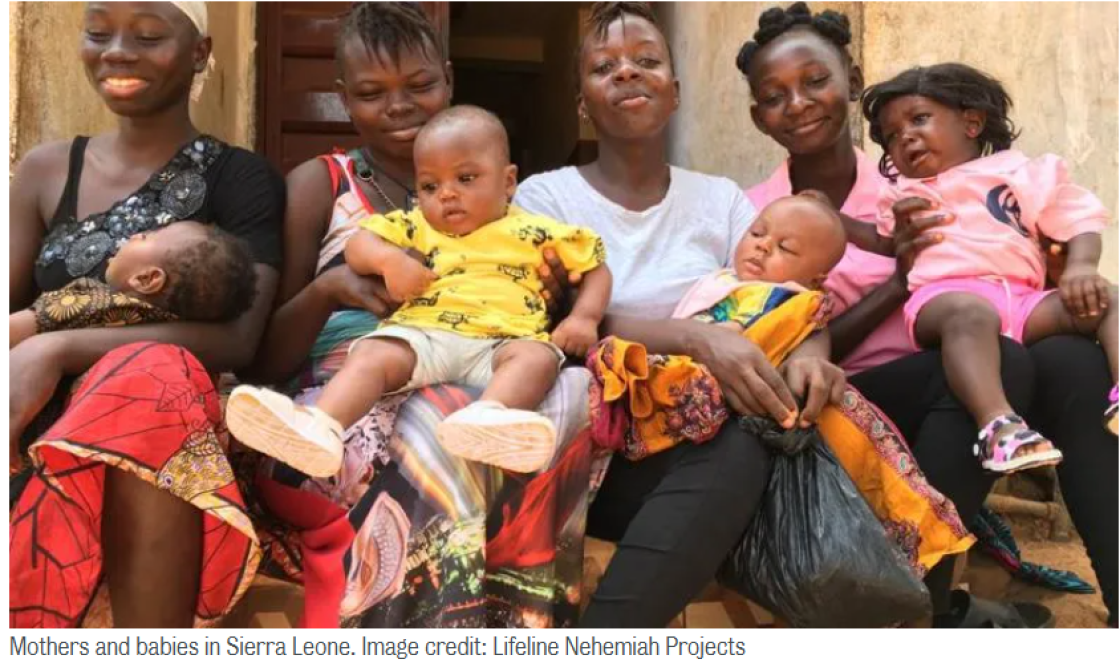
An innovative community-based mentoring scheme for pregnant adolescent girls in Sierra Leone has been found to save lives, while also helping girls return to education.
reduction in combined maternal and perinatal deaths
girls mentored saved one baby’s life
pregnant girls across 12 communities in 5 districts
The pilot trial, published in The Lancet, was led by researchers at King’s College London, including ARC maternity researchers, in collaboration with local NGO Lifeline Nehemiah Projects (LNP).
The trial ran between July 2022 and November 2023 across twelve communities in five districts of Sierra Leone. Girls were assigned to a local mentor to support them during and after their pregnancy.
How the mentoring scheme worked
The mentors provided vital support for the girls, many of whom faced enormous stigma and family abandonment. They helped the girls:
✓
Access antenatal care
✓
Meet other pregnant women
✓
Reconnect with family
✓
Financially support themselves and their babies
Girls who took part in the project have been able to return to school, pursue vocational training in plumbing, electrical installation, hospitality and tailoring, or develop their businesses.
“This is the first time we have seen just how powerful a locally developed and led community-based mentoring scheme can be for pregnant adolescent girls and their babies — a clear example of why global health research should focus on local solutions to local problems.”

Lead author; Senior Research Fellow, King’s College London
Beyond clinical results: social impact
2YoungLives founders Lucy November and Mangenda Kamara from LNP are keen to highlight that the clinical results of the trial don’t reveal the full extent of the social impact of the scheme.
“The trial goes far beyond clinical results, as it has helped these girls to thrive beyond their pregnancy. The business start-up fund provided a sustainable income, allowing them to eat well during pregnancy and save for their babies. And many of the girls were able to return to school or followed vocational training after giving birth.”
Midwife Research Fellow, Department of Women & Children’s Health, King’s College London; co-founder, Lifeline Nehemiah Projects
Sierra Leone maternal mortality: the context
Maternal mortality in Sierra Leone has steadily fallen in recent years, from being one of the worst in the world to better than the average rates in sub-Saharan Africa.
maternal deaths per 100,000 live births in 2013
maternal deaths per 100,000 live births in 2020 — a 40% reduction
Despite this progress, Sierra Leone remains one of the countries with the highest maternal mortality ratio in the world. And even when mother and baby both survive, poverty and school exclusion mean that girls rarely get back on their pre-pregnancy trajectory with education and its associated economic benefits.
The researchers also recommend capitalising on learning from this pilot study to conduct a larger trial before scaling up in Sierra Leone and elsewhere, including high-income countries.
“Many of the interventions in the scheme could also have a reciprocal benefit for communities in the UK. In particular, it could help groups of women who are poorly served — maybe they don’t speak English or find care hard to access.”

Professor of Social Science and Women’s Health, King’s College London; ARC maternity and perinatal research theme lead
About 2YoungLives and CRIBS
2YoungLives
Started by LNP in 2017 with just 3 mentors and 9 mentees. By 2021 the scheme had 24 mentors and had mentored over 300 girls, with no maternal deaths recorded. This pilot trial is the first to formally evaluate the impact of the project.
In 2021, 2YoungLives became part of CRIBS (Capacity Research Innovation Building maternity Systems) — a global health group funded by the NIHR that aims to reduce maternal mortality and build research capacity in Sierra Leone.
📄
Read the full paper
Community-based mentoring to reduce maternal and perinatal mortality in adolescent pregnancies in Sierra Leone (2YoungLives): a pilot cluster-randomised controlled trial
Related content
- →
Capacity Research Innovation Building maternity Systems in Sierra Leone (CRIBS) — ARC-adopted research - →
Blog: Innovations to reduce maternal mortality and build research capacity in Sierra Leone — Dr Cristina Fernández Turienzo - →
Continuous care from community-based midwives reduces risk of preterm birth by 45% - →
Maternity and perinatal mental health research at ARC South London
Original source: arc-sl.nihr.ac.uk — NIHR ARC South London legacy content archived May 2026.