
30 Jul Conference highlights urgent need to support families with children’s social care involvement in the first 1001 days of a child’s life
Home › News & insights › Latest news
30 July 2025
Conference highlights urgent need to support families with children’s social care involvement in the first 1001 days of a child’s life
Social workers, clinicians, policymakers, people with lived experience and researchers gathered for a hybrid conference on 15 July 2025, to discuss how to improve support and care for families with children’s social care involvement during pregnancy and the first two years of life.
in person at King’s College London, Bush House
joined online
The event profiled individuals with lived experience, practitioners, researchers and policymakers, across talks and panel discussions, calling for more empathic systems that can handle complexity and nuance.
The conference was hosted jointly by researchers at King’s College London, the charity Birth Companions, the National Perinatal Epidemiology Unit at the University of Oxford, Lancaster University and the NIHR Applied Research Collaboration South London.
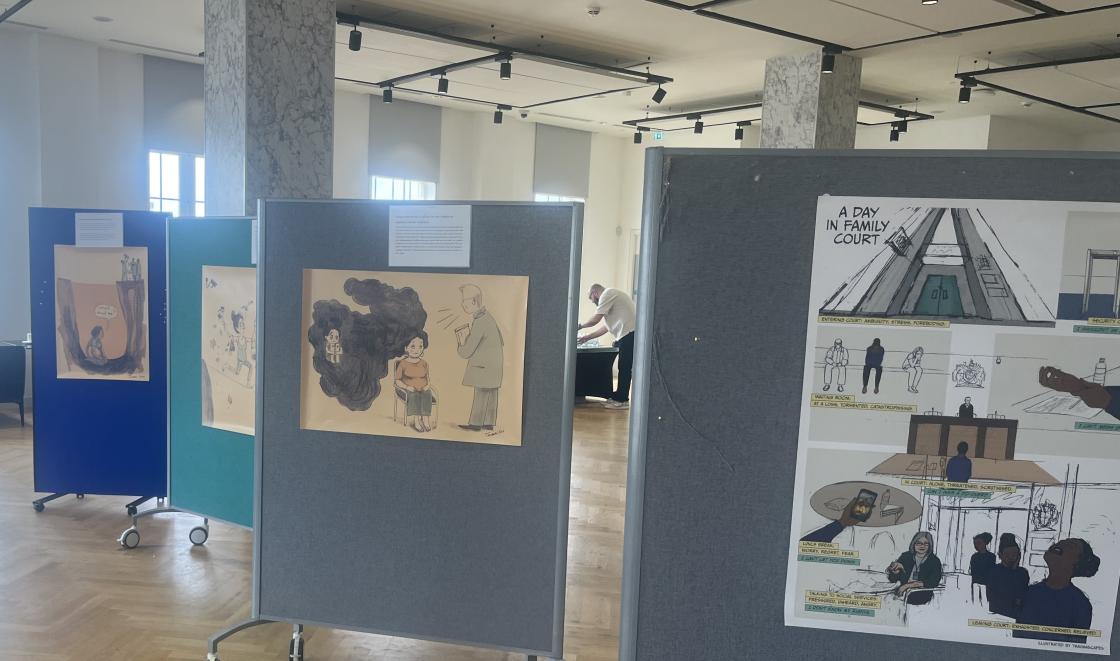 Display of poster illustrations for the MUMS@RISC study by illustrator Tonka Uzu.
Opening the conference
“We really need to influence hearts and minds to bring about change for families. Policy and practise both only work if we really listen to the people who are using the system.”
Angela Frazer-Wicks MBE — Chair of the Board of Trustees, Family Rights Group & Founding member of the Parents Panel (conference chair)
“Relationships nurture development and buffer the impact of adversity. But relationships do not happen in a vacuum. Past and current adversity and stress makes it harder for parents to provide sensitive, nurturing care.”
Sally Hogg — Assistant director, The Royal Foundation Centre for Early Childhood
“To everyone here today – we are a collective of change makers. We know what the problem is and we know where we need to get to. But we have to work out how – together.”
Isabelle Trowler CBE — Chief social worker for children & families
Voices of lived experience
Women with lived experience from Birth Companions and the advisory panel from the MUMS@RISC study shared their views on the power of lived experience informing research and practice, and what is needed to improve support:
- “I am not a bad person – I was in a bad situation. There needs to be more education around mental health and domestic abuse, otherwise you cannot properly understand someone’s situation.”
- “We are more than the label we are given and the box we are put into.”
- “We want to be part of the solution and not just the problem.”
- “We are not just what is written on paper. We are your best port of call when it comes to knowing what is wrong with the system and how it can be fixed.”
Key research findings presented
Researchers shared findings from recent work on the topic:
✓
A third of all women in the UK who died during pregnancy or the year after between 2014 and 2022 had children’s social care involvement
✓
The rate of newborn babies in care proceedings is rising: in 2011 it was 40% of infants, but by 2023 it was 52% (Centre for Child and Family Justice Research at Lancaster University)
✓
There is a north-south divide in care proceedings. Living in London is associated with a much lower chance of a newborn being in care proceedings than in the north of England; rates of deprivation also map on to this picture
✓
Younger children are most likely to be subject to placement orders and to be adopted
✓
Access to perinatal mental health and support services for women with substance abuse problems or in treatment varied substantially across the country
✓
A study of 200 most recently concluded court cases found that in one third of cases at least one parent had learning disabilities or learning difficulties, but this was not identified early enough, so communication about the proceedings was inadequate
✓
Previous contact with children’s social care sets women up for a cycle of involvement — for example, half of the women who took part in MUMS@RISC interviews grew up in the care system themselves
“There are some real challenges ahead if we want to make care better for these families. But our research also found some examples of high-quality care where professionals rallied together to advocate for women and their families. Women shared in interviews how kindness and compassion made them feel seen, heard and supported – which can be lifesaving.”
Kaat De Backer — Research associate, King’s College London, ARC South London maternity and perinatal mental health theme (conference organiser)

Clean Break Theatre performance
In the afternoon the audience was captivated by a performance from Clean Break Theatre Company. ‘Scenes from Lost Mothers’ shone a light on the real experiences of women navigating pregnancy and separation from their babies while in prison. The work is based on The Lost Mothers project, carried out by Dr Laura Abbott at the University of Hertfordshire, and was developed alongside women with experience of the criminal justice system, or those at risk of entering it.

Closing reflections
Delegates took part in discussions in breakout rooms, before reconvening at the end of the day to consolidate their reflections and talk about next steps.
“We may come to this from different angles and organisations, but the themes and conversation across breakout groups are remarkably similar: we need better connected systems, and understanding that giving families a voice makes things better for everyone.”
Angela Frazer-Wicks CBE — Conference chair
Call for evidence
Birth Companions are calling for evidence of services and support for women who have involvement from children’s social care in pregnancy and early motherhood, using a short survey to inform the co-design of a new National Care Pathway.
The survey is open to all, including health and social care professionals and wider service providers; individuals and families with personal experience of children’s social care contact; academics, policymakers and the voluntary sector.
📋
Share your evidence
Help inform the co-design of a new National Care Pathway for families with children’s social care involvement.
Find out more
- →
Impact case study: Improving healthcare and support for families with children’s social care involvement during pregnancy and the first two years of life - →
The MUMS@RISC study adopted by ARC South London - →
Characteristics, outcomes, and maternity care experiences of women with children’s social care involvement who subsequently died: national cohort study and confidential enquiry (BMJ Medicine, July 2025)
▶ View the recordings of the day
- →
Children’s social care involvement in the first 1001 days: changing hearts and minds (part one) - →
Children’s social care involvement in the first 1001 days: changing hearts and minds (part two) - →
View the visual illustrations from the event by Tonka Uzo
📄 View the presentation slides
- →
Claire Mason and Dr Bachar Alrouh, Lancaster University — Nuffield Family Justice Observatory Born into Care Research - →
Dr Polly Radcliffe, King’s College London — The Stepping Stones study: Best practice and care pathways for perinatal women who are dependent on drugs - →
Prof Katy Burch, Oxford Brookes University — Babies in care proceedings: What about parents with learning disabilities or difficulties? - →
Erica Hayhoe and Kaat De Backer, King’s College London — The MUMS@RISC study: Maternity characteristics, outcomes and experiences of mothers with children’s social care involvement - →
Kirsty Kitchen, Birth Companions — Children’s Social Care involvement in the first 1001 days: the policy picture
Original source: arc-sl.nihr.ac.uk — NIHR ARC South London legacy content archived May 2026.