Capacity Research Innovation Building maternity Systems in Sierra Leone (CRIBS)
Home › Research and implementation › Our research areas › Maternity and perinatal mental health
1 November 2022 — adopted November 2021
Capacity Research Innovation Building maternity Systems in Sierra Leone (CRIBS)
This NIHR Global Health Research Group aims to reduce deaths of mothers and their babies in Sierra Leone.
What is the health problem?
1 in 17
women in Sierra Leone die in pregnancy — one of the most dangerous places in the world to give birth
Nearly half of these deaths occur in adolescents, due to poor access to care. When a mother dies, her child is 10 times more likely to die within the first two years.
Three quarters of women die from bleeding, infection or blood pressure problems — all of which can be identified by measuring blood pressure and heart rate, and are preventable with simple, cheap interventions. But Sierra Leone lacks monitoring equipment and training, meaning women lack timely, lifesaving care.
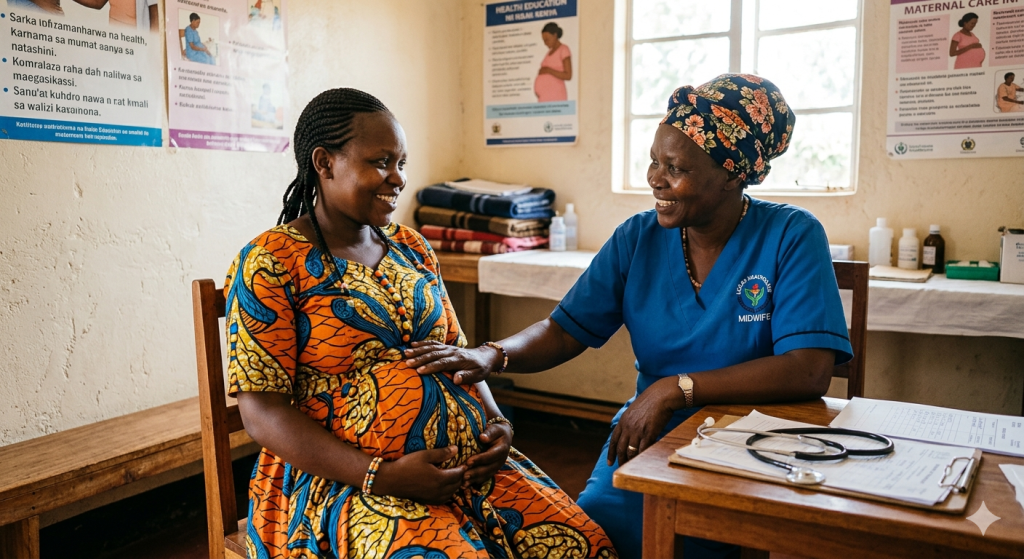
CRIBS (Capacity • Research • Innovation • Building maternity Systems) builds on research partnerships spanning the last five years in Sierra Leone, formalising the collaboration between King’s College London and the University of Sierra Leone.
Programme aims
To develop and implement simple, scalable innovations to reduce maternal and perinatal mortality and build research capacity and expertise in Sierra Leone. Through equitable partnerships and ongoing stakeholder engagement, we hope to drive delivery of sustainable, evidence-based, effective maternity and newborn care.
Professor Jane Sandall CBE — Professor of social science and women’s health, King’s College London

Our partnership organisations
King’s College London (UK lead)
Led by Professor Andrew Shennan
University of Sierra Leone (SL lead)
Led by Professor Sahr Gevao
Ministry of Health & Sanitation, Sierra Leone
Led by Dr Sartie Kenneh
iNGO led by Dr Venetia Goodhart — 12+ years delivering complex health system strengthening programmes
Lifeline Nehemiah Projects
Community-based solutions NGO led by Prince Tommy Williams, with unique skills in community engagement
National Midwifery Schools, Sierra Leone
Led by Dr Joan Shepherd
About the research team
The research group is multidisciplinary and includes King’s College London (KCL) researchers:
Prof Andrew Shennan • Prof Jane Sandall • Prof Lucy Chappell • Dr Andrew Leather • Dr Kate Bramham • Dr Harriet Boulding • Mr Paul Seed • Dr Alexandra Ridout • Dr Cristina Fernandez Turienzo • Dr Katy Kuhrt • Lucy November
Alongside Sierra Leonean colleagues: Dr Joan Shepherd (midwifery), obstetric colleagues, PhD student Dr Francis Moses, and gender studies specialist and PhD student Mangenda Kamara.
How the project will be carried out
Research methods include: hybrid cluster trials, observational studies, surveys, semi-structured interviews, focus group discussions and photovoice — a visual research methodology. The main workstreams are:
CRADLE Vital Signs Alert Monitor evaluation
Evaluation of the CRADLE Vital Signs Alert (VSA) Monitor throughout the country, leading to earlier detection of women who are deteriorating due to common pregnancy-related problems (including Shock Index and a test to identify kidney failure)
Community-based intervention for pregnant teenagers (2YoungLives)
Introduction and evaluation of a locally designed community-based intervention targeted to pregnant teenagers, to improve access to care and education, and to better understand how blood pressure problems affect the health of this group
Cost-effectiveness and scale-up evaluation
An evaluation of how cost-effective it would be to introduce the CRADLE VSA and related interventions at scale in Sierra Leone, and the pathways to dissemination by government
Building local research capacity
Supervision of three PhD students (implementation science, health policy and health economics), inclusion of research training into the National School of Midwifery Curriculum, mentoring for medic/midwife academics, and creation of Sierra Leone’s first Patient and Public Involvement Initiative to give women and community members a new voice
How patients and the public are involved
The CRIBS group is guided by the community engagement and involvement (CEI) experience of its partners. CEI activities are designed to empower women and their support networks to have control over decisions that most affect their lives, aligned with community and national priorities.
CEI activities include:
✓
Initial engagement events for local community leaders
✓
Site initiation workshops for local communities and healthcare providers using participatory action research techniques (social mapping, picture codes, spider-grams, structured life narratives)
✓
Co-development of culturally appropriate materials and infographics
✓
Programme newsletters and regular study progress updates
✓
Interviews and focus groups with pregnant women, care providers and study champions
✓
Informal feedback via WhatsApp groups
✓
Dissemination events with local, national and international research community and public; co-development and publication of a community engagement strategy and case study
Potential benefits of the project
Reduction in maternal & perinatal mortality
Improvements in health and wellbeing
Development of local research capacity & expertise
Related content
- →
CRIBS and PAPAGAIO teams highly commended in NIHR Impact Prizes 2025 - →
Blog: Innovations to reduce maternal mortality and build research capacity in Sierra Leone — by Dr Cristina Fernandez Turienzo - →
CRIBS Global Health Research Group website - →
Maternity and perinatal mental health research at ARC South London
Original source: arc-sl.nihr.ac.uk — NIHR ARC South London legacy content archived May 2026.