Improving healthcare and support for families with children’s social care involvement during pregnancy and the first two years of life
Home › Research and implementation › Our research areas › Maternity and perinatal mental health
21 August 2025
Our ARC’s maternity and perinatal mental health researchers have collaborated with people with lived experience and charities to explore how to improve support for families with children’s social care involvement during the first two years of life. This research is influencing policy and informing public and professional awareness.
babies in UK state care (2023, ONS)
The number of babies placed in state care in the UK has nearly doubled in 10 years. Until recently, evidence about women’s experiences and outcomes in this situation has been limited.
Our impact at a glance
✓
Our research found that a third of women who died during or after pregnancy were known to children’s social care (CSC), highlighting the need for more trauma-informed care
✓
Our research highlighted the complex healthcare experiences of women and healthcare professionals
✓
Findings have generated significant media interest and been presented to policymakers at NHS England and the Department of Health and Social Care
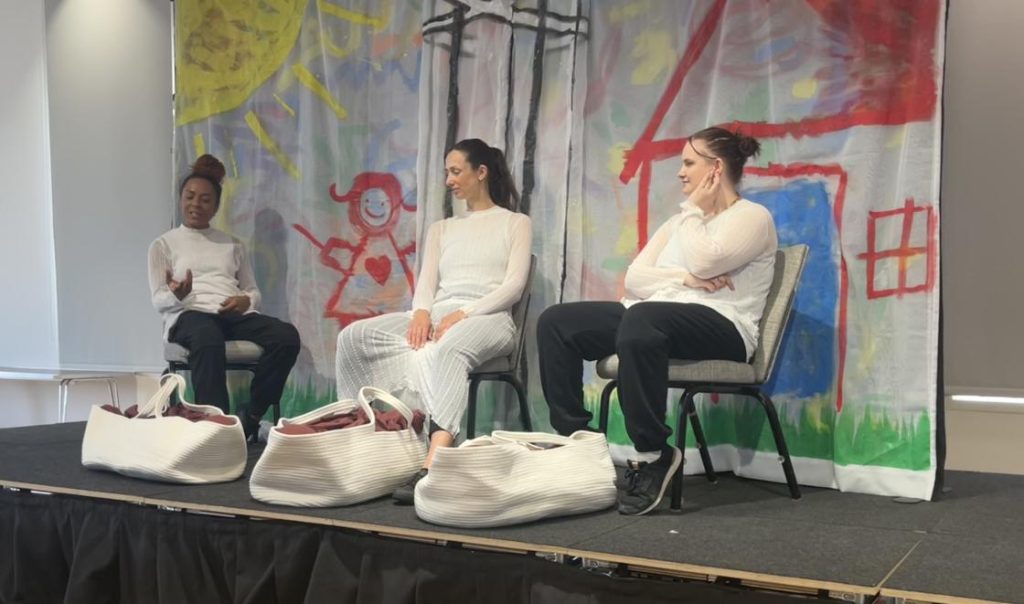 Clean Break Theatre company performing ‘Scenes from Lost Mothers’.
What is the health problem?
The first two years of a child’s life are critical for their development. For women with social risk factors, such as those experiencing substance misuse, domestic abuse or learning disabilities, children’s social care services (CSC) may become involved during this time.
While CSC play a crucial role in supporting vulnerable families, their involvement can complicate the relationship between parents and their health and social care professionals. A common fear for women is around the risk of their child being placed in state care.
The last decade has seen a rise in CSC involvement for children. Most children in care proceedings in England are under the age of one, with more than half being newborns. Despite the scale of the problem, evidence about women with CSC involvement during pregnancy and the postnatal period has been limited.
Working collaboratively to address the evidence gap
Our ARC’s maternity and perinatal mental health theme, through NIHR research fellow Kaat De Backer’s PhD work, collaborated with people with lived experience, the charity Birth Companions, Oxford Population Health and University of Lancaster to address this evidence gap through the MUMS@RISC study.
The researchers explored maternal characteristics, outcomes and experiences of women in contact with CSC in the perinatal period, particularly mothers facing separation from their infant.
Our findings
Using a range of methods and data sources, the researchers:
✓
Revealed that a third of women who died during or in the year after pregnancy were known to CSC — highlighting the urgent need to prioritise and improve mothers’ care
✓
Highlighted the complex healthcare experiences of women and healthcare professionals
✓
Made recommendations for a trauma-informed and skilled workforce, improving multi-agency collaboration, and for healthcare systems to prioritise building trust
Influencing policy and increasing awareness
This research is influencing policy and informing public and professional awareness. Research findings have generated significant media interest — including in The Guardian and on BBC Radio 4 Woman’s Hour — and have been presented to policymakers at NHS England and the Department of Health and Social Care through policy meetings, to inform future policy.
The researchers have worked with people with lived experience and collaborators to produce a report summarising research findings from the study.
“This study has given a voice to birth mothers. It has forced a microscope on our reality, evidencing the shortcomings of a fractured system. We hope it will raise greater awareness of what is happening to those, like us, who struggle to advocate for themselves and are faced with red tape, lack of compassion and a ‘one size fits all’ approach.”
Martha — on behalf of the MUMS@RISC lived experience advisory panel
Findings were presented at an ARC South London conference in July 2025 with more than 300 attendees, including policymakers, clinicians, social workers, service managers, psychologists, lawyers, women with lived experience, charity workers and campaigners.
Testimonials from conference participants:
- “The day was sensitively and well planned, thought provoking and provided excellent insights and information on the topic. The excellent inclusion of all of the women with lived experience brought really important perspectives and emphasised the humanising and compassionate approach needed in this work.”
- “The voices of women with lived experience … really put perspective on the topic and reinforced how women need support, not their child removed.”
- “All the research was very well introduced to us online and to the people in person. You could feel the empathy and the commitment of everyone.”
- “Perfect blend of data and research and insight from lived and learned experience.”
Our recommendations for action to improve support
Supporting families with children’s social care involvement can be challenging, but there is some very good practice underway in parts of the country, building and delivering excellent support. Unfortunately, these efforts are often in spite of, rather than supported by, the wider systems in which they operate.
●
Routine enquiry about domestic abuse during antenatal and postnatal contacts, mandated by the Domestic Abuse Act 2021, needs to be robustly implemented across healthcare settings, in order to identify and support those at risk.
●
Consideration of ‘risk’ requires a holistic approach, grounded in the current, individual circumstances of each woman and her family. Medical and social risk, and their interactions, must be jointly considered. This requires multi-disciplinary teamwork and communication, within and between health and social care partners.
●
Integrated care models, such as one-stop-shop models, need to be tested and adapted to tailor multidisciplinary care around the complex physical, mental and social needs of pregnant and postnatal women.
●
When women are facing removal of their baby, a person-centred approach is essential to avoid further trauma. Assumptions around birth or feeding preferences should make space for compassionate conversations about their wishes, and these should be respected as much as possible.
●
Separation at birth must always be approached with compassion. Interventions, such as Hope boxes, can support connection, dignity and compassion, and minimise trauma for everyone affected.
●
Enhanced postnatal follow-up after infant separation is critical, both by maternity and mental health services.
Training to facilitate these improvements — whether about domestic abuse enquiry, trauma-informed care, meaningful conversations about social risk factors or supporting women through separation — has to be given the same status as training in clinical skills, as it can equally be lifesaving.
Who could benefit?
If our research recommendations are implemented nationally, they could contribute to safer care and improved outcomes for women and babies. Specifically, they could help:
- Families in contact with CSC during pregnancy and early parenthood, including those facing separation from their baby
- Health and social care professionals being enabled to provide better and more compassionate care and support
- Health and social care systems by ensuring adequate focus is given to the most underserved and marginalised women and their families
“The MUMS@RISC study is hugely valuable in centring the significance of the first 1001 days, and the role that CSC services can, and should, play in supporting parents to give their baby the best possible start in life. But it also shows us that services and systems are often unable to meet the needs of pregnant women and mothers in the most complex and traumatic situations, with sometimes tragic results.”
— Head of Policy, Birth Companions

Find out more
Research publications
- →
Separation at birth due to safeguarding concerns: Using reproductive justice theory to re-think the role of midwives (June 2024) - →
Healthcare experiences of pregnant and postnatal women and healthcare professionals when facing child protection in the perinatal period: A systematic review and Critical Interpretative Synthesis (July 2024) - →
Characteristics, outcomes, and maternity care experiences of women with children’s social care involvement who subsequently died: national cohort study and confidential enquiry (July 2025) - →
Report: Understanding the characteristics, outcomes and experiences of women with children’s social care involvement during pregnancy and early motherhood. A summary from the MUMS@RISC study (October 2025) 📄 PDF
Media coverage
- →
A third of UK women who died during or after pregnancy known to children’s services, study finds — The Guardian (10 July 2025) - →
BBC Radio 4 — Woman’s Hour (10 July 2025)
ARC South London news
- →
Conference highlights urgent need to support families with children’s social care involvement in the first 1001 days of a child’s life - →
‘Support, not judgement’: study explores links between children’s social care involvement and maternal deaths - →
New research on how to improve healthcare for women and babies when child protection services are involved - →
MUMS@RISC study project page — Maternity experiences and perinatal outcomes of mothers separated from their babies due to social care proceedings
Original source: arc-sl.nihr.ac.uk — NIHR ARC South London legacy content archived May 2026.